
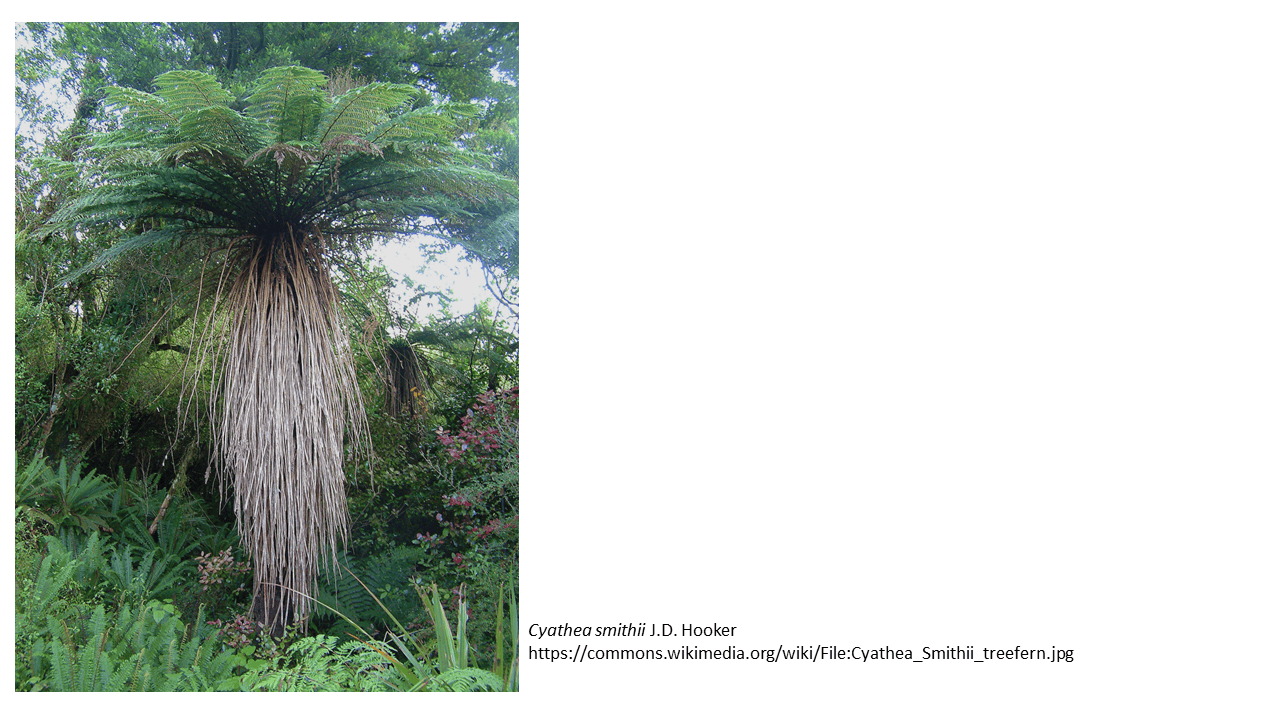
Although liquid in vitro cultures are a well-established method for multiplying plant cells and a source for obtaining plants on a massive scale, as well as a pathway for producing a range of valuable secondary metabolites, in the case of ferns, this type of culture was only described in 2022 by our Garden's biotechnology team. The study included tree ferns Cyathea smithii, which is native to New Zealand, where it grows up to 8 meters tall. It is one of the few woody ferns that can survive occasional snowfall and frosts down to about -5oC. A distinctive feature of this species is the maintenance of a "skirt" of dry leaves on the vertically erect rhizome, which protects the meristem from adverse environmental conditions.
The research conducted allowed to describe the structure and growth potential of the cell suspension C. smithii which provides a basis for further experimentation. Extacts prepared from plant tissue showed antimicrobial activity against Staphylococcus aureus, Escherichia coli i Pseudomonas aeruginosa, which can find practical use.
Rybczynski JJ, Kazmierczak A, Dos Santos Szewczyk K, Tomaszewicz W, Miazga-Karska M, Mikula A 2022 Biotechnology of the tree fern Cyathea smithii (J.D. Hooker; Soft tree fern, Katote). II. Cell suspension culture: focusing on structure and physiology in the presence of 2,4-D and BAP. Cells 11, 1396. https://doi.org/10.3390/cells11091396
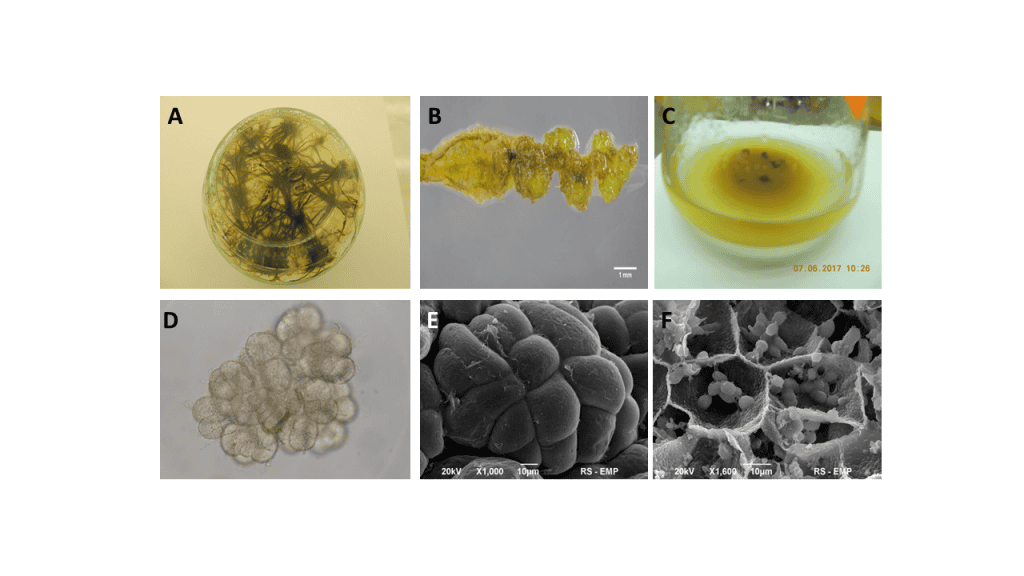
Steps leading to the derivation of liquid culture Cyathea smithii: (A) obtaining sterile in vitro culture of plants on agar medium (view of root system as viewed from the bottom of the jar); (B) root fragment with visible callus tissue used to initiate suspension cultures; (C) liquid culture of callus tissue cells; (D) suspension cells - light microscope image; (E) suspension cells - scanning electron microscope image; (F) cells C. smithii As an object of experimentation - the visible interior of the cells.
post
post
2022-09-19 09:09:32

 English
  Polish