
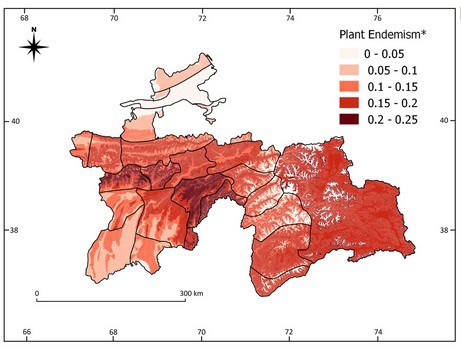
In a period of constant climate change, identifying factors affecting species diversity is a key element in determining ecological patterns and major conservation goals. Such research is particularly important if it involves areas with the world's highest biodiversity, known as hotspots. In an article that appeared in the journal Scientific Reports, we present the results of a recent study on the patterns and drivers of plant endemism in Tajikistan, a country in the global biodiversity hotspot Mountains of Central Asia. We used three groups of variables to see which climatic factors have the greatest impact: 1) the modern climate, 2) the climate of the last glaciation, and 3) climate stability expressed as the difference between the modern climate and the climate of the last glaciation. The results show that the climate of the last glaciation and its past changes have the greatest impact on modern patterns of endemism in Tajikistan, revealing evolutionary relationships between range-limited plants and past climate. Changing temperature and precipitation regimes as the climate continues to warm may therefore increase the threat to Tajikistan's geographically isolated plants, and their potential to escape to suitable habitats is highly topographically restricted.
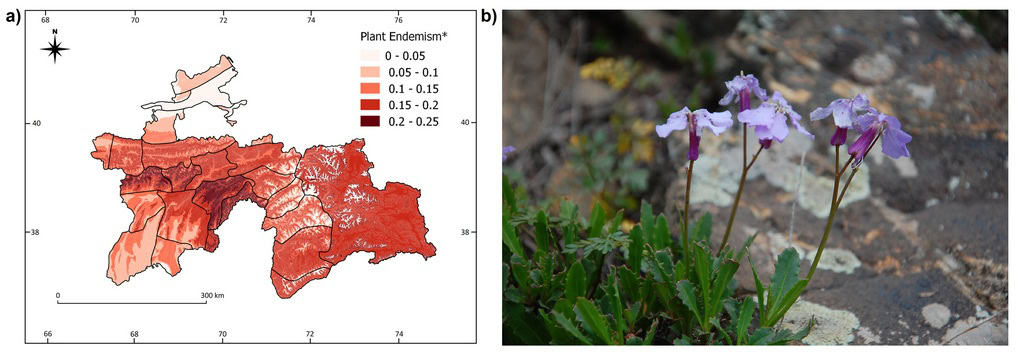
Figure 1. (a) Distribution of plant endemism in Tajikistan (*proportion of endemic species to total plant species richness). (b) Parrya schugnana - An endemic species with a low degree of threat (LC category, Nowak et al. 2020), which, with climate change, may become an endangered species.
Radula M., Cricket S., Nobis M., Nowak S., Nobis A., Nowak A. 2021. Palaeoclimate has a major effect on the diversity of endemic species in the hotspot of mountain biodiversity in Tajikistan. Scientific Reports, 11: 18684 (https://doi.org/10.1038/s41598-021-98027-3)
post
post
2021-09-22 07:00:48

 English
  Polish