
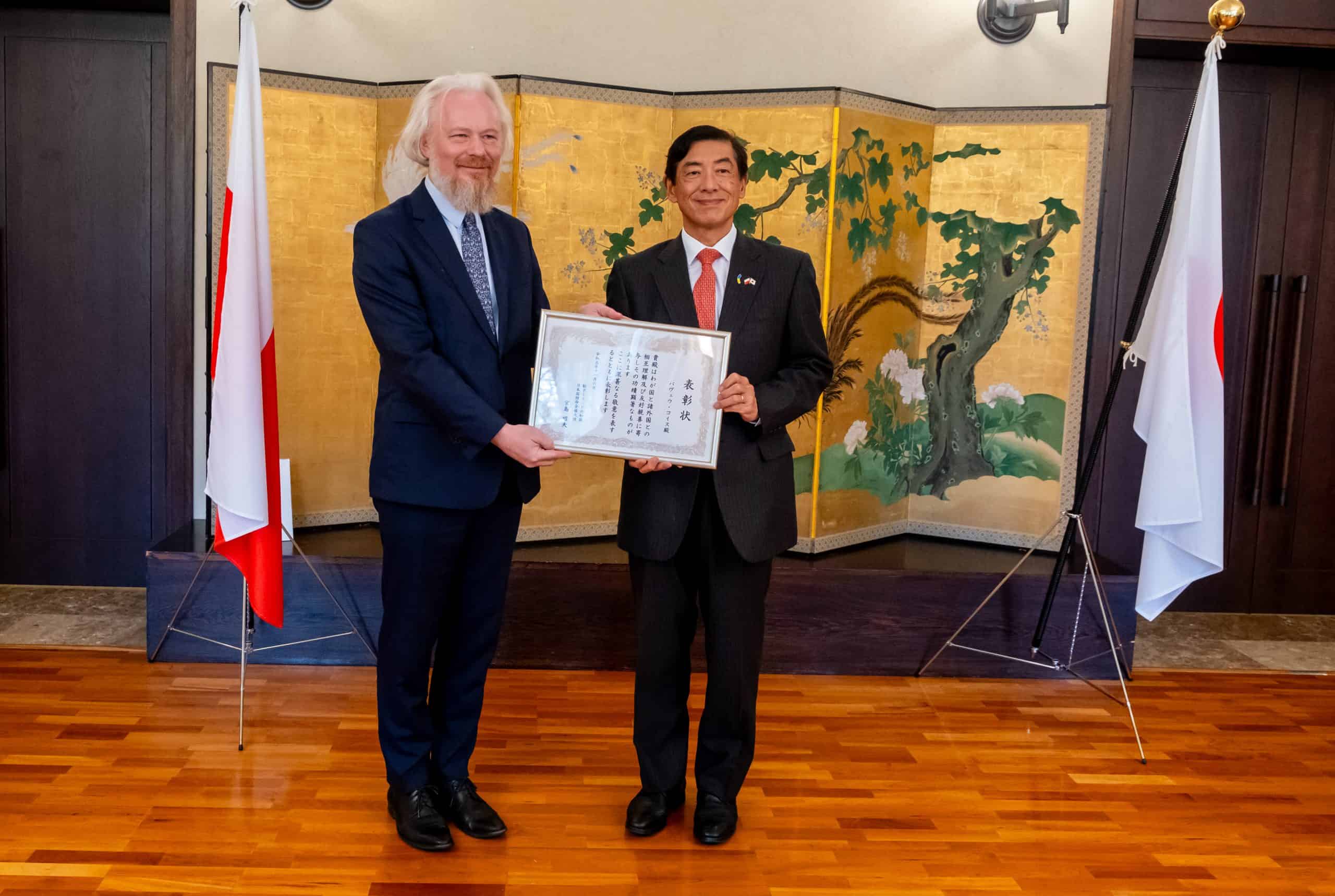
Yesterday, at a ceremony at the Japanese residence, Akio Miyajima presented the Diploma of the Japanese Ambassador to the Deputy Director of the Powsin Botanical Garden, Dr. Pawel Kojs.
This is a high honor awarded to Poles who make special contributions to strengthening Polish-Japanese relations and promoting Japan in our country.
Mr. Pawel Kojs, who served as director of the Garden from 2017 to 2021, was recognized for his exemplary preparation of the visit of His Imperial Highness the Heir to the Throne Prince Akishino and Her Imperial Highness Princess Kiko in 2020. The monarchs planted an 'Autumnalis Rosea' (Prunus × subhirtella) cherry tree on the grounds of the Reiwa Sakura Teien Japanese cherry collection, which had been established a year earlier. That same year, the Garden hosted members of the Japan Cherry Blossom Association and The Public Interest Incorporated Foundation for International Peace from Japan. However, what has been particularly noted is the Japan Month held in April since 2017. During this time, the Botanical Garden is filled with a series of meetings, exhibitions, concerts, lectures, workshops, visits by Japanese scientists, cultural people, travelers, tourists or, last but not least, representatives of the Embassy of Japan headed by ambassadors - first Tsukasa Kawada and now Akio Miyajima. And all this amid dozens of cherry trees, magnolias and azaleas blooming in white and pink.
The director of the Garden, Prof. Arkadiusz Nowak, was asked to deliver a laudation, who stressed that in the history of Japanese-Polish relations this was the first time a botanist had been honored with such a distinction. He pointed out the immense merits and wisdom of Dr. Kojs, which is expressed both in scientific excellence, special managerial skills, but also in the now rare ability to discuss any topic. - Dr. Kojs is a figure dedicated to the development of botanical gardens in Poland, sensitive to beauty, with deep historical reflection, though equally aware of the present and focused on the needs of both individuals and institutions. At the same time, the laureate shares many traits in common with the Japanese: modesty, prudence, moderation, sometimes melancholy, but above all respect for nature. People with this set of qualities are often called "beautiful" - concluded Professor Nowak.
GALLERY


Mr. Pawel Kojs would not be himself if in his speech he did not mention the many people who support him on a daily basis - co-workers, family and friends. He stressed the great value in life of being surrounded by warm and kind people.
Such people in his professional life are undoubtedly Prof. Jerzy Puchalski - former long-time director of the Botanical Garden in Powsin - and Prof. Romuald Zabielski - former vice president of the Polish Academy of Sciences, initiator of Japan Month and Sakura Report, author of an album on sakuras, organizer of photo exhibitions about Japan... Both professors supporting and kindly mobilizing activity.
In his speech, Director Kojs did not fail to emphasize the role of his colleagues from the botanical gardens with which he is associated (the Silesian Botanical Garden and the Botanical Garden of the Polish Academy of Sciences) in the implementation of many important initiatives. There was also no shortage of thanks to the parents present at the ceremony, who in difficult moments keep his spirits up and support him in his life decisions. He expressed his gratitude to all those, thanks to whom, he stressed, he receives this honorable award.
When I have thought about why Japanese culture is close to me, it seems to come from sharing a certain longing for kindness, courtesy and curiosity that comes from maturity rather than emotional appeal. A longing for sublime grace and earned gentleness, which does not come from character, but from patient and long-lasting formation of it, respect and love for work, great perseverance, willingness to make sacrifices and at the same time the ability to enjoy the everyday small things. It longs for a lack of ostentatiousness, but at the same time for the long-term pursuit of large and complex goals. Finally, it is a culture of a deep-rooted sense of honor and the importance of one's word. In all of this, I find unintuitive, intriguing and immensely attractive the power of Japanese society to overcome the hardships of everyday life and face the challenges of the future. It comes at a high price, but great things cost a lot. Pawel Kojs
 English
  Polish