
The periodical Agriculture Ecosystems & Environment published an article by Prof. Arkadiusz Nowak's team on underground biodiversity (5,567, 200 pts.).
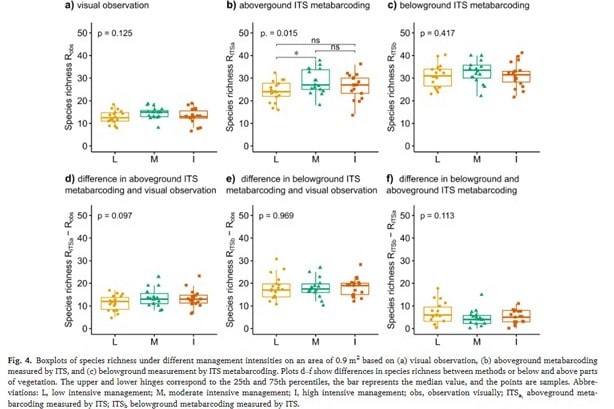
Using eDNA metabarcoding, the proportions between above- and below-ground parts of vegetation in three types of grassland were recognized for the first time. Factors such as moisture, fertility and intensity of use on the species composition of grasslands were also analyzed. The eDNA metabarcoding successfully assigned some 93% taxa at the species level. Our study revealed that the below-ground plant community consists of up to 66% more species compared to the above-ground portion identified by conventional vegetation surveys. However, this difference shrinks to about 25% when taxonomic assignment derived from eDNA was also applied to the aboveground portion of the phytocenosis. We also found that the difference between the sub- and aboveground parts of the plant community decreased as soil fertility increased. We found that management intensity significantly affects species richness only in the aboveground part of the vegetation, while the underground part of the grassland remains preserved.
Rucińska A., Świerszcz S., Nobis M., Zubek S., Boczkowska M., Olszak M., Kosiński J.G., Nowak S., Nowak A. 2021 Is it possible to understand a book missing a quarter of the letters? Unveiling the belowground species richness of grasslands. Agriculture Ecosystems & Environment 324:107683
DOI: 10.1016/j.agee.2021.107683
Abstract: Knowledge of species richness patterns in plant communities is biased toward its hidden belowground part and is derived only from the part visible aboveground. Studies on the relationship of the above- to belowground parts of plant communities suffer from the lack of a consistent and uniform approach to assess their taxonomic composition, particularly in species-rich ecosystems. This study described the proportion between above- and belowground parts of vegetation in three grassland types along with the environmental factors that affect them, using eDNA metabarcoding and an observer survey. The internal transcribed spacer 2 (ITS2) region was used to analyze the total plant richness in the soil and the aboveground "green" part of plant communities. Considering all samples, eDNA metabarcoding successfully assigned about 93% of taxa on the species level. Our findings support the notion that metabarcoding analysis of the belowground plant community revealed up to 66% higher species richness than was identified above the ground by a conventional vegetation survey. However, this difference decreases to about 25% when an eDNA-derived taxonomic assignment was applied for the aboveground part of phytocoenosis. We also found that the difference between the below- and aboveground parts of the plant community decreased with increased soil fertility. Finally, the management intensity was found to significantly influence species richness only in the aboveground part of vegetation with the belowground part of grassland remaining unaffected. Overall, since DNA-based metabarcoding and traditional vegetation surveys have limitations, their complementary use is recommended to obtain the most reliable vegetation description. However, it should be considered that metabarcoding analysis is destructive and may not be applicable in protected or private areas or on permanent research plots.

post
post
2021-12-10 09:10:29

 English
  Polish